The Measuring Room
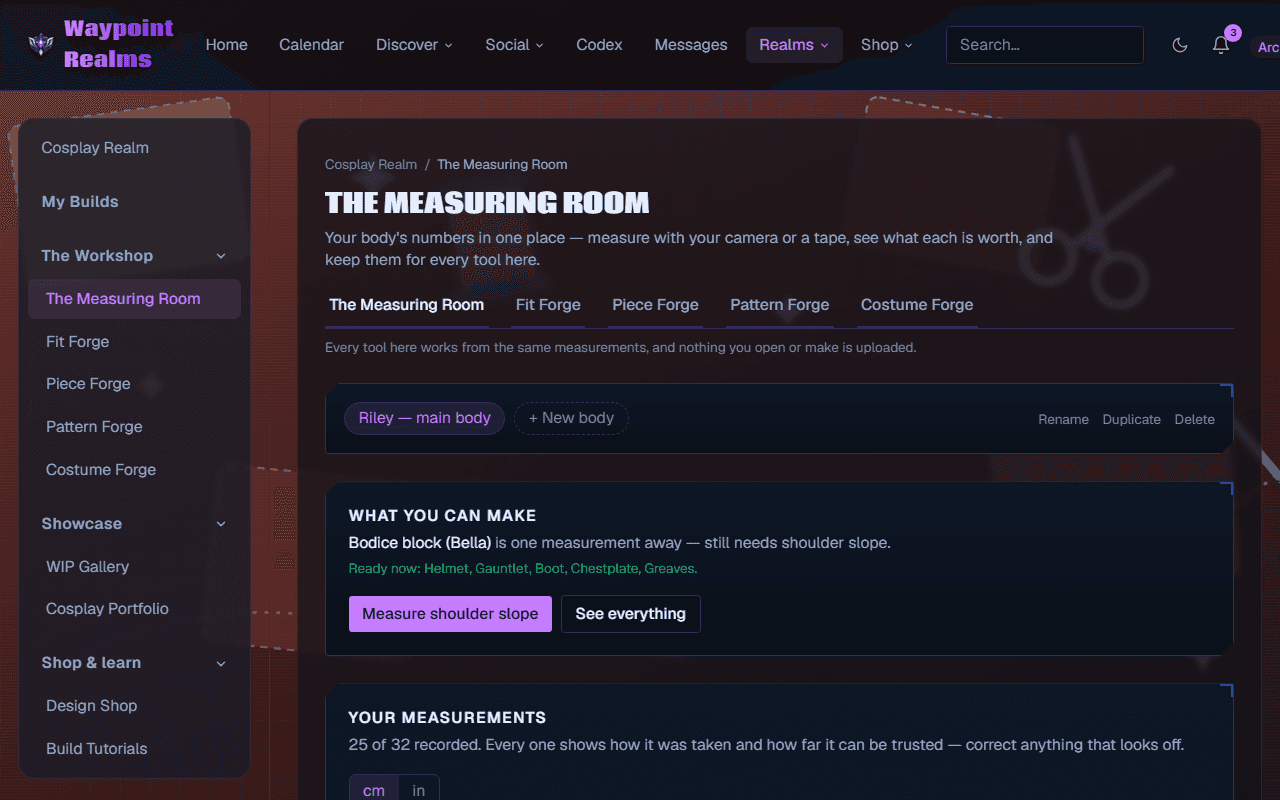
Take your measurements with a phone camera or a tape, keep them in one place, and see how each was taken and how much to trust it. Every Workshop tool reads from here.
The Measuring Room is where the Workshop starts. It holds your body's numbers in one place so that scaling a helmet, drafting a bodice or assembling a costume never asks you for them again.
You do not need all of them
There are 32 measurements. Almost nobody needs 32. The room works backwards from what you're making — scaling a helmet needs exactly one, a fitted bodice needs about twelve — and tells you which ones are still missing for the thing in front of you. Measure those; ignore the rest until something asks.
Two ways to measure
With a tape
Type in numbers you already have, or follow the guided walkthrough one part at a time. A tape is not the fallback for when the camera struggles — it is the most accurate option there is, and the room records it as such.With your phone's camera
Photograph one part at a time with something of known size in frame for scale — a bank card is ideal, because every bank card in the world is the same size. Mark the card, mark the measurement, and the room does the arithmetic.
The photo never leaves your device
Measuring without an object in frame
A full-length photo has nowhere convenient to hold a bank card. So the room can calibrate you instead: take one close-up shot where it measures your head height against the iris of your eye — an iris is very close to 11.7 mm in every adult — and from then on your own head is the scale reference for full-length shots. Calibrate once; after that you need no object at all.
Why the iris only ever measures your head
Every number carries its own error bar
This is the part worth understanding, because you are going to cut foam against these numbers. Each measurement remembers how it was taken and how much to trust it, and the room shows that next to the value everywhere it appears:
- Tape — the highest confidence available.
- Camera — good, and honest about awkward angles: a measurement taken at a bad angle is labelled lower-confidence rather than quietly presented as exact.
- Typed — a number you brought in yourself, trusted as far as its source.
A measurement derived from another approximate one drops a tier — so a body measurement scaled against your head, which was itself scaled against your iris, is labelled rough. It is still useful. It is just not pretending.
Measurements go stale
Bodies change. After about six months the room starts saying a number is getting old, and says how old out loud. That is a nudge and never a gate — a stale measurement still pre-fills, still scales a model, still drafts a pattern. Re-measure the ones that matter for what you're building now.
More than one body
You can keep several profiles with + New body — your own plus anyone you build for. Each keeps its own measurements, its own provenance, and its own staleness threshold, and every Workshop tool lets you pick which body it is working from.
Still stuck? Browse all help or contact us. To report someone or something, use the report action on the relevant profile, post, or session — it sends us the context automatically.