AI credits — what they are and what they cost
Every AI Game Master turn spends credits. Your plan includes some each month, and you can buy more.
The AI Game Master costs real money to run, so it is metered in credits. Every plan includes credits each month; if your table plays more than that, you can buy a top-up.
What's included each month
| Plan | Credits per month | Models you can run |
|---|---|---|
| Free | 10 | Standard |
| Plus | 100 | Standard |
| Pro | 250 | Standard and premium |
Your allowance arrives at the start of each billing period. It does not roll over — credits you bought do.
What a turn costs
- Standard — 1 credit a turn. Fast, and good for most play.
- Premium — 4 credits a turn. Noticeably better at holding a long story together and at reacting to something you did twenty sessions ago. Included on Pro; on Plus, it runs on credits you buy (your monthly credits stay on Standard).
The GM chooses the model per campaign, in the campaign's Settings under AI model, and the credits come out of the GM's balance — not each player's. Your players never need credits of their own. If the GM's plan or bought credits can't cover Premium, the turn runs on Standard instead of stopping.
Other AI tools spend credits too
Buying more
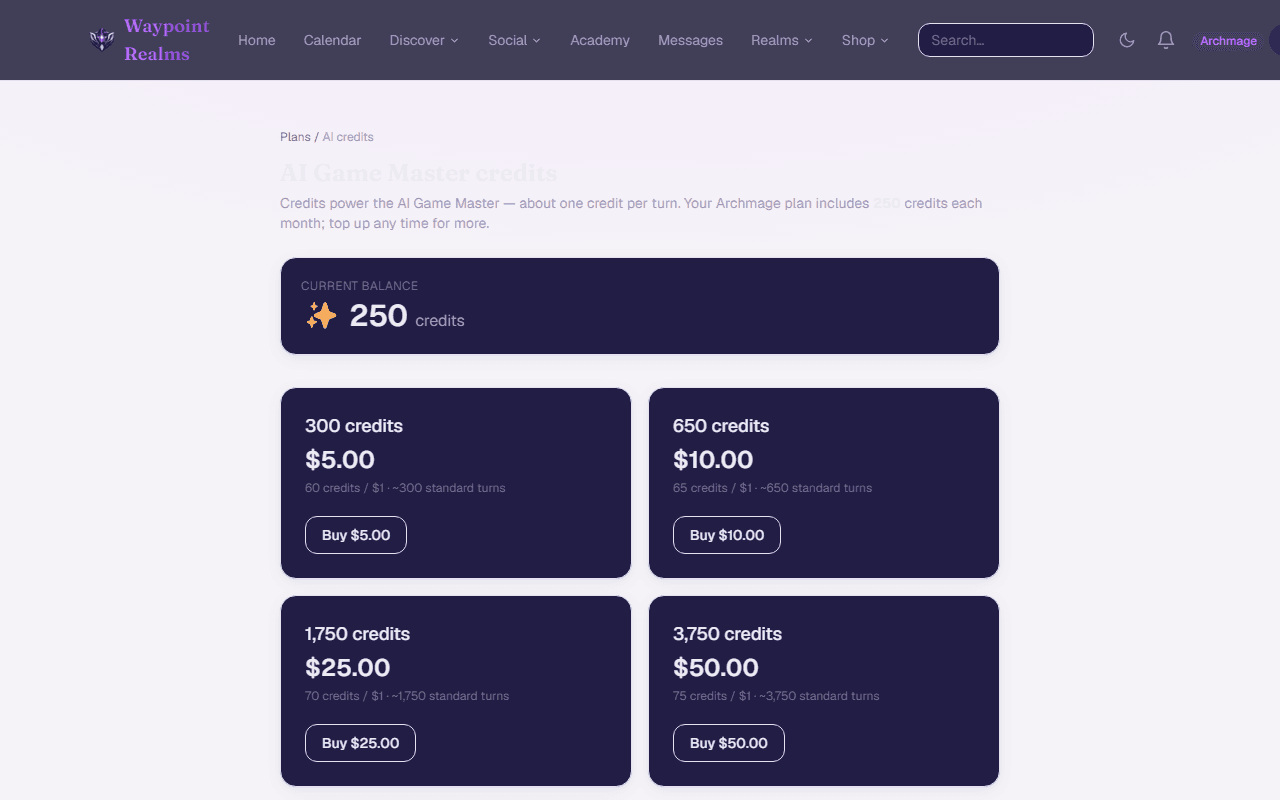
Top-ups live at AI credits. Every pack is the same rate — 350 credits for $5, and proportionally up to 7,000 for $100 — so a bigger pack is convenience, not a discount. Pro members get 10% more credits on every pack.
Purchased credits never expire and are spent only after your monthly allowance is used up.
Credits are not how we make money
Free credits
- Invite a friend. When someone you invited joins and actually plays, you both get credits — see invites and referrals.
- Upgrade. Moving up a plan raises your monthly allowance from the next period.
Running out mid-session
The GM sees the balance in the campaign before it becomes a problem, and the turn that would take you under zero is refused rather than half-run. Nothing is lost: buy a pack and carry on from the same point, or switch the campaign to the standard model, which stretches the same credits four times as far.
Still stuck? Browse all help or contact us. To report someone or something, use the report action on the relevant profile, post, or session — it sends us the context automatically.