
LARP safety calls & consent tools
The calls that stop a scene — Hold, Man down, Time out — the consent tools that let you steer one, and the physical-safety basics, with the reminder that your game's own briefing always wins.
LARP runs on a small shared vocabulary that anyone can use to stop or steer a scene. The Safety & Rules Reference in the LARP Realm collects the calls most systems share, so a first-timer is not learning them for the first time in the middle of a fight.
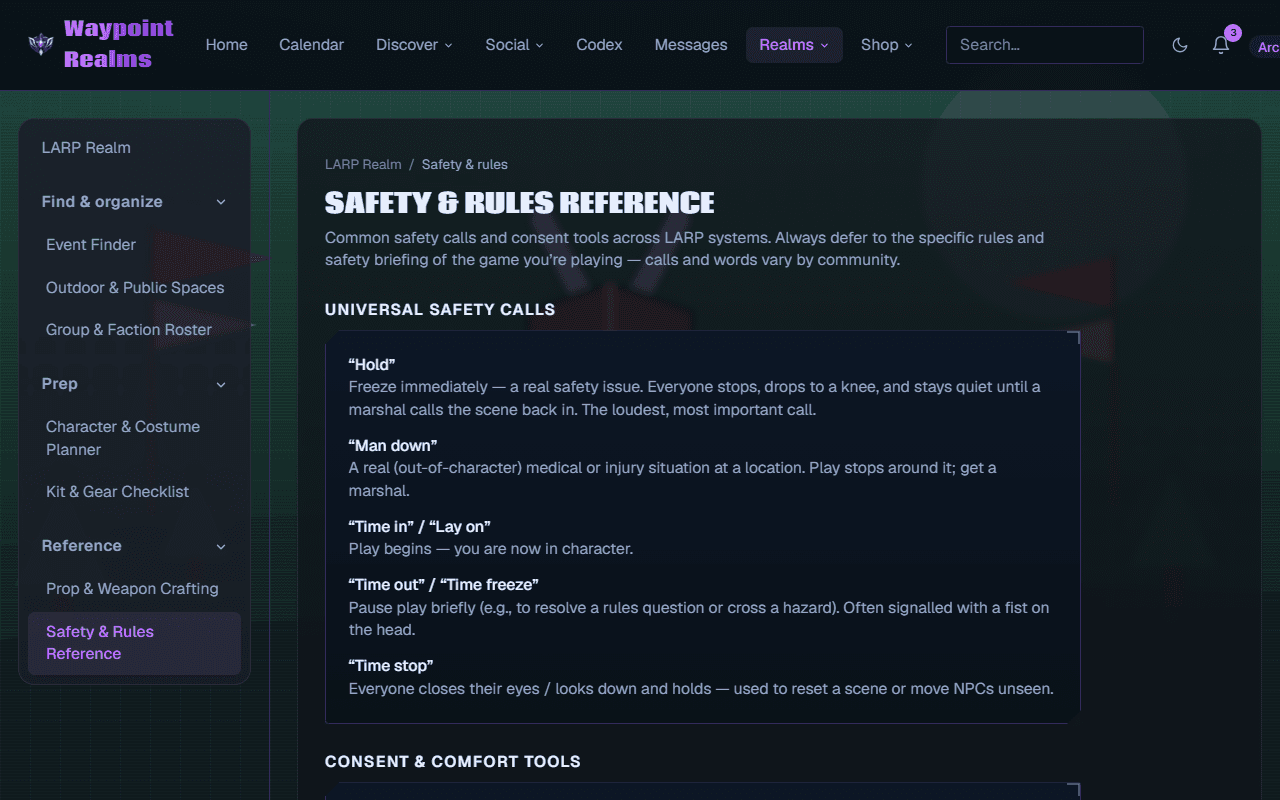
The calls
- “Hold” — the loudest and most important one. Freeze immediately: a real safety issue. Everyone stops, drops to a knee, and stays quiet until a marshal calls the scene back in.
- “Man down” — a real, out-of-character medical or injury situation at a location. Play stops around it; get a marshal.
- “Time in” / “Lay on” — play begins. You are in character from here.
- “Time out” / “Time freeze” — pause briefly to resolve a rules question or cross a hazard.
- “Time stop” — everyone closes their eyes or looks down and holds, so a scene can be reset or NPCs moved unseen.
Your faction's own calls
A faction can keep its own set of calls. On the reference, each of your factions' sets follows the universal calls, labelled with the faction's name; a faction with none says the universal set applies. The LARP Realm's home page shows the first four calls of your active character's faction when it has a set, and the universal four otherwise.
Leaders and officers edit the set on the faction's Safety calls tab (or follow Add your faction's calls from the reference). Press + Add a call and fill in its name, the Word or gesture (optional) and the Meaning, or press Start from the universal calls on an empty set. Reorder with the arrows, then press Save calls. A faction holds up to 30 calls. Anyone who can see the faction can read them; a public faction's calls are readable signed out.
Consent & comfort tools
Beyond the emergency calls, most games carry tools for steering a scene without stopping play for everyone. The reference lists four:
- “Check-in” / “OK check” — flash the OK sign with eye contact (or ask quietly). Thumbs-up is fine, a wavering flat hand is unsure, thumbs-down is not OK. Anything but a thumbs-up — including no answer — means drop character and check on them.
- Look-down / “I'm not here” — a hand or fist on the head, a hand over the eyes, or eyes to the ground: that person is out of character or a non-present NPC. Don't interact.
- “Cut” — in some systems, stops one interaction that's too intense; softer than a full Hold.
- Negotiation & opt-outs — set boundaries before play, and respect a “no” instantly, in or out of character.
Physical safety basics
The reference ends with the basics: weapons checked at the safety table before play and after hard hits; light, controlled contact with no head, neck or groin shots; watch the terrain; drink water and dress for the weather; and know where first aid, the marshals and the nearest road access are before the game starts.
Was this helpful?